
For many foreigners arriving in Japan, the first housing decision is not about finding a perfect long-term home. It is about choosing a practical first base that matches your budget, privacy needs, move-in timing, and ability to handle communication in Japanese.
- When a share house is easier for a first arrival
- When a monthly apartment is worth the higher setup cost
- What to check before paying for housing from overseas
- How HarukaBase can support communication in Japanese and emergency-contact needs
Share House vs Monthly Apartment in Japan: Quick Answer
This guide answers a common question: share house vs. monthly apartment in Japan. It is especially useful for foreigners choosing a first home base before arrival.
A share house can reduce furniture and utility setup when those items are included in the actual offer. A monthly apartment may suit you better when a private kitchen, bathroom and independent daily routine are priorities. Neither category is automatically cheaper or easier: compare the exact room, included items, payment timing and provider conditions for the same stay.
The best choice is not necessarily the cheapest room. Choose by minimum stay, payment timing, commute, privacy, provider rules, and communication in Japanese.
First-month housing decision map
Short stays usually need flexible housing. Long-term rental contracts need more checks.
A share house is more social and usually easier to move into. A monthly apartment is more private and independent.
Availability changes quickly, so payment may be needed soon after approval.
communication in Japanese, emergency contact, and utility checks can change the route.
Share House vs Monthly Apartment: Cost, Privacy, and Setup
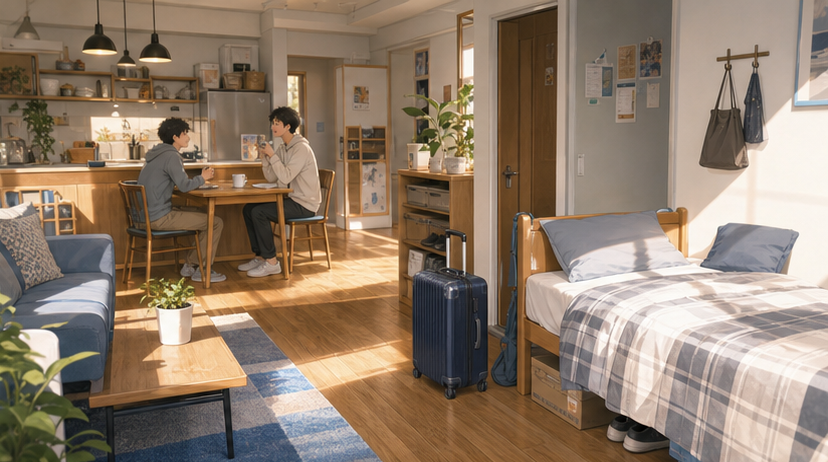

Best for
- Share house: A first stay in Japan, working holiday participants, and people who want less setup work.
- Monthly apartment: People who want privacy, a quiet room, and more independent daily life.
Setup
- Share house: Often easier because furniture and common facilities are already prepared.
- Monthly apartment: Usually more private, but you must check what is included and what is not.
Cost style
- Share house: Can be easier to understand, but shared rules and common areas matter.
- Monthly apartment: Can cost more at the start, and cleaning, bedding, utilities, or fees may be separate.
Communication
- Share house: Provider rules, house rules, and move-in instructions still need careful checking.
- Monthly apartment: Communication in Japanese can be more important because the unit is more independent.
Risk
- Share house: You may have less privacy or different lifestyle expectations from housemates.
- Monthly apartment: You may pay more before arrival and need faster decisions when availability appears.
Share House vs Monthly Apartment in Japan: What Foreigners Should Check
- Minimum stay and whether one month is charged even for a shorter stay
- Move-in date, payment deadline, and cancellation rules
- Whether utilities, bedding, Wi-Fi, cleaning, and key fees are included
- Whether a Japan-side emergency contact is required by the provider
- How far the room is from your school, work, or first-week errands
- Whether communication is available in English or only in Japanese
When a Share House Is Usually the Better Choice
A share house often works well when you want a furnished room, a simpler move-in process, and fewer utilities to arrange yourself. It can also be practical for a working holiday or an initial stay while you learn the city.
When a Monthly Apartment Is Usually the Better Choice
A monthly apartment is often worth considering when privacy, quiet, and having your own kitchen or bathroom matter more than the lowest upfront cost. Confirm exactly which furniture, appliances, utilities, and cleaning fees are included.
Compare the Total Move-In Cost
Do not compare rent alone. Ask about deposits, administrative fees, cleaning, bedding, utilities, key fees, and cancellation charges. A room with higher rent can still cost less overall if more essentials are included.
Use the same arrival date, move-out date and number of occupants for both quotes. Then separate the amount you must pay before getting the keys from the cost of the whole stay. A refundable deposit can affect your cash needs without being the same as a nonrefundable fee; do not subtract it as a guaranteed refund.
Exact room, occupants and stay dates
- Share-house quote: Record the quoted room and dates
- Monthly-apartment quote: Use the same dates and occupants
Rent starts / keys available
- Share-house quote: Record both dates separately
- Monthly-apartment quote: Record both dates separately
Rent for the whole agreed stay
- Share-house quote: Include any charged days before arrival
- Monthly-apartment quote: Include any charged days before arrival
Nonrefundable initial charges
- Share-house quote: List contract, cleaning and other required fees
- Monthly-apartment quote: List contract, cleaning and other required fees
Utilities, Wi-Fi and bedding
- Share-house quote: Included, extra, capped or still unknown?
- Monthly-apartment quote: Included, extra, capped or still unknown?
Deposit and return conditions
- Share-house quote: Record amount, deductions and return timing
- Monthly-apartment quote: Record amount, deductions and return timing
Cash due before keys
- Share-house quote: Record the actual invoice and deadline
- Monthly-apartment quote: Record the actual invoice and deadline
Cancellation / early departure
- Share-house quote: Record notice, charges and any refund conditions
- Monthly-apartment quote: Record notice, charges and any refund conditions
Mark an unanswered item “not confirmed”, rather than entering zero. If utilities are included up to a limit, ask how extra usage is charged. If a cleaning fee is already part of the initial invoice, do not add it again to the stay total. Keep any HarukaBase support fee separate from the housing provider's charges.
A provider example: Oakhouse's move-in guidance describes a nonrefundable contract fee and an initial rent payment calculated according to the start date. For starts late in the month, that initial payment can include the next month's rent. Its rent-start rules can also begin charges before your physical arrival, depending on when a room is reserved or becomes available. These are Oakhouse's conditions, not rules for every share house or monthly apartment. Check the exact property and current written quotation.
For example, if one quote covers only the first partial month while the other includes the following month, their initial invoices are not a fair price comparison. Align the dates first. Also compare how much cash each option needs before you travel, even when their total stay costs are similar. This is an editorial comparison method, not a live property quote or a promise of savings.
Before paying, ask: “For my stay from [date] to [date], what is the total amount due before key collection, which charges cannot be refunded, and on what date does rent begin?” Add your expected arrival date if it differs from the contract start. Keep the answer with the quote and cancellation terms.
Is the lower monthly rent always the cheaper option?
No. Compare the full agreed stay and required extras. The lower advertised rent may require a larger initial payment, and the higher rent may include items you would otherwise pay separately. You need the actual written conditions to decide.
Can I assume the deposit comes back in full?
No. Ask about deductions, inspection, payment method and return timing. Until those terms are clear, keep it as cash you must provide and a conditional possible refund.
Check Privacy and House Rules
In a share house, ask about guests, quiet hours, shared kitchens, bathrooms, and cleaning duties. In a monthly apartment, check building rules, trash collection, noise expectations, and how to report maintenance problems.
Can You Apply Before Arriving in Japan?
Many furnished options accept applications from overseas, but providers may request a passport copy, visa information, arrival date, payment, or a local contact. Confirm the screening process before sending money.
Will You Need an Emergency Contact?
Requirements differ by property. Some providers ask for a Japan-side emergency contact, while others use a guarantor company or a different screening process. Ask which role is required because an emergency contact is not the same as a financial guarantor.
Where HarukaBase can help
HarukaBase can help you compare practical housing options, explain provider conditions in English, and communicate with Japanese housing providers before move-in. In many cases, foreign applicants are asked for a Japan-side emergency contact. When the property allows it and you meet the requirements, HarukaBase may be able to help with this part of the application.
If you are still choosing your first Tokyo area, read our Tokyo first-month area guide. If you already know you need housing help, start from Housing Support in Japan for Foreigners.
Sources checked: Japan housing and living information from MLIT and JETRO. Housing availability, costs, and provider rules change, so HarukaBase confirms current details before you apply.
Share House vs Monthly Apartment in Japan: Final Checklist
Tell us your area, budget, stay length, privacy level, and arrival date. We can help compare share houses, monthly apartments, and other practical housing options before you pay.
Cost-comparison section and provider example checked October 29, 2026 by HarukaBase editorial support. The worksheet is an editorial planning tool; no property booking, customer case or savings result is claimed.