The most useful thing to know about Japan garbage rules is that there is no single sorting chart for every address. Your municipality sets the local collection rules, and your building or accommodation tells you how to use its collection system.
Before buying bags or copying a neighbor, find the current local guide and confirm the correct collection point. This guide helps new residents and short-term guests turn those instructions into a routine they can actually follow.
What you will learn
- How to find the guide and calendar for your own address.
- Why plastics, PET bottles and collection times need local checks.
- What to do when your garbage bag is not collected.
- Which questions to ask your host or property manager.
Prepared by HarukaBase Editorial. Official sources checked September 29, 2026. Local examples below are examples, not nationwide instructions.
Japan Garbage Rules: Find the Rules for Your Address
The goal is to answer four practical questions: what category, which bag or container, where to put it, and when. A category name alone is not enough to decide how to dispose of something.
Start with the municipality, then confirm the building system
Use your full address to identify the city or ward responsible for collection. Search its official website for the English garbage guide and the calendar for your neighborhood. The Ministry of the Environment explicitly notes that sorting and disposal rules differ by municipality.
Next, ask the building manager where residents are permitted to leave each category. A dedicated garbage room may have instructions that differ from a street collection point. Access to a room does not by itself mean every type of garbage can be left there at any time.
Save these together on your phone
- The official guide for your current municipality.
- The collection calendar for your neighborhood.
- A photo of your building's posted instructions.
- The contact for questions about a rejected or unusual item.
If the city guide and building notice appear to conflict, ask the manager to explain the collection arrangement. Avoid deciding that whichever rule is more convenient must apply.
Three examples of why a nationwide chart can mislead
These official examples show why advice from another city needs checking. They are not a complete comparison of each city's system.
| Local example | What the official guide says | What to confirm at your address |
|---|---|---|
| Shinjuku City | Its household guide specifies the designated collection day and an 8 a.m. deadline. | Your neighborhood's day and assigned collection point. |
| Hiroshima City | Its English living guide specifies an 8:30 a.m. collection-day deadline. | The calendar and category for your district. |
| Yokohama City | Its current plastic-resource category includes some all-plastic products, with size and material exceptions. | Whether your item meets the current conditions. |
Sources: Shinjuku household sorting guide, Hiroshima English living guide and Yokohama English sorting guide.
Do not carry a remembered rule unchanged to your next apartment. Even a familiar word such as “plastic” can describe a different collection category after a move or a municipal update.
Use common categories as questions, not final answers
You may encounter burnable waste, non-burnable waste, plastics, cans, glass bottles, PET bottles and paper. Treat these as headings to look up in your local guide, not a universal set of bins.
| Item in your hand | Question to check locally |
|---|---|
| Food scraps or a dirty container | How should food residue be removed, and what if the container cannot be cleaned? |
| A plastic hanger or storage box | Does the plastic category include products, or only specified packaging? |
| A drinks bottle | Is it PET or glass, and where do its cap and label go? |
| A delivery box | Must cardboard be flattened, tied, kept dry or collected separately? |
| Broken glass | What wrapping and labeling are required to protect collectors? |
For an unfamiliar item, use the municipality's item search if available. For example, Yokohama's English Mictionary is an item lookup tool for Yokohama residents. Its answers are not rules for the rest of Japan.
A PET bottle, its cap and its label are separate decisions
A plastic drinks bottle can create more than one sorting step. In Yokohama's guidance, PET bottle preparation includes removing the cap and label, rinsing and flattening the bottle; the cap and label go with plastic resources. Check your own municipality's preparation instructions before copying that sequence.
Do not assume every transparent bottle is a PET drinks bottle. Check the material and what it contained, then look up that type of container. A shampoo bottle and a water bottle should not be grouped together solely because they look similar.
A practical first-week exercise
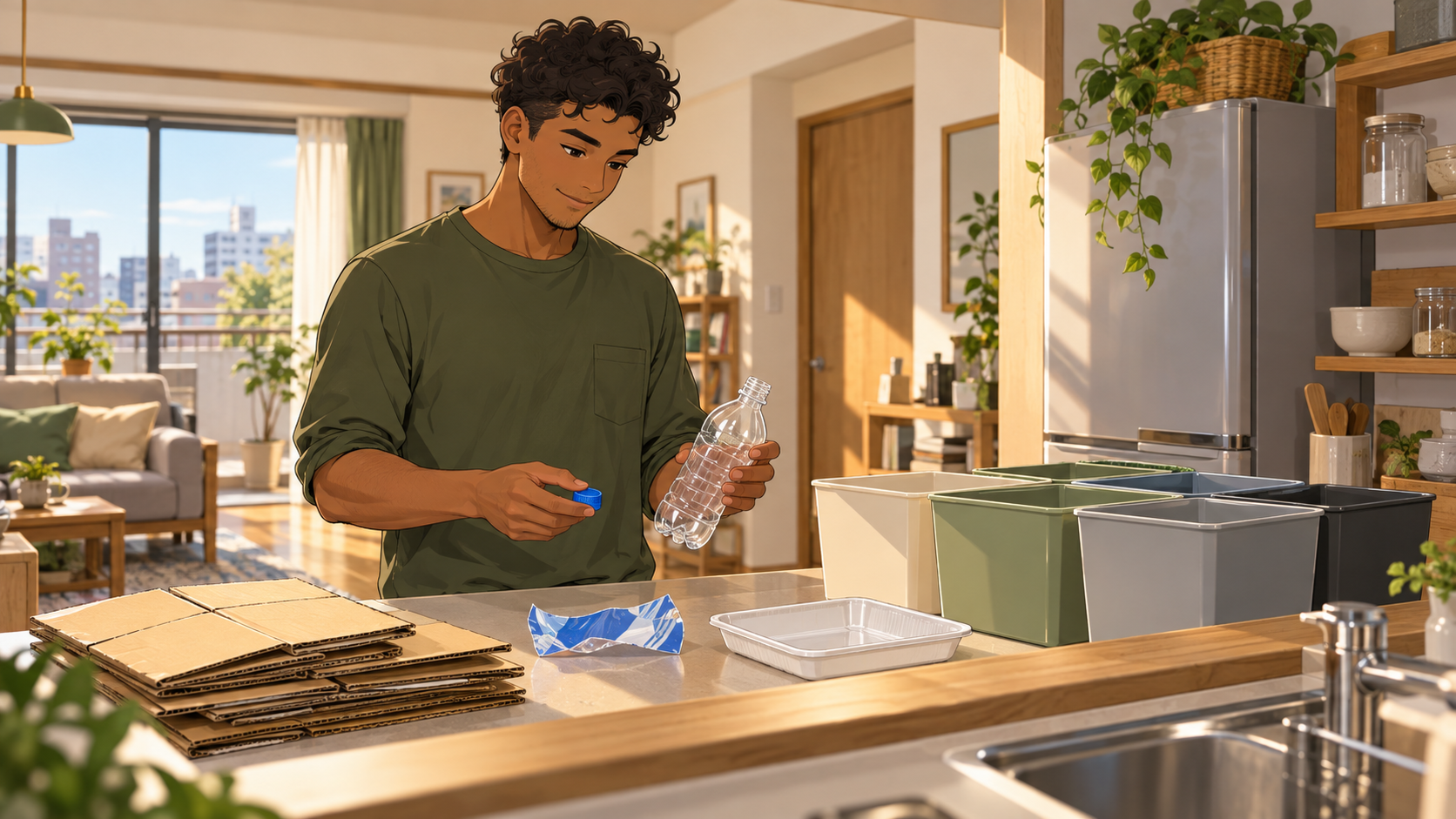
Take one empty drinks bottle to your local sorting guide. Identify the bottle, cap and label individually, then write their destinations on your own bin labels. This worked exercise is more useful than memorizing a color scheme from another apartment.
You do not need an elaborate set of bins on day one. First establish the categories, then choose containers that fit the space and the collection routine.
Confirm collection days, bags and the exact drop-off point
Ask which bags or containers are accepted before buying a large supply. Check the official schedule for each category, including holiday changes. Do not assume collection days are identical throughout a city or that a bag left after the truck has passed will be taken that day.
Some municipalities publish calendars by year and collection area. Ashiya's FY2026 English calendar page is an example of why both date and location matter when choosing a document.
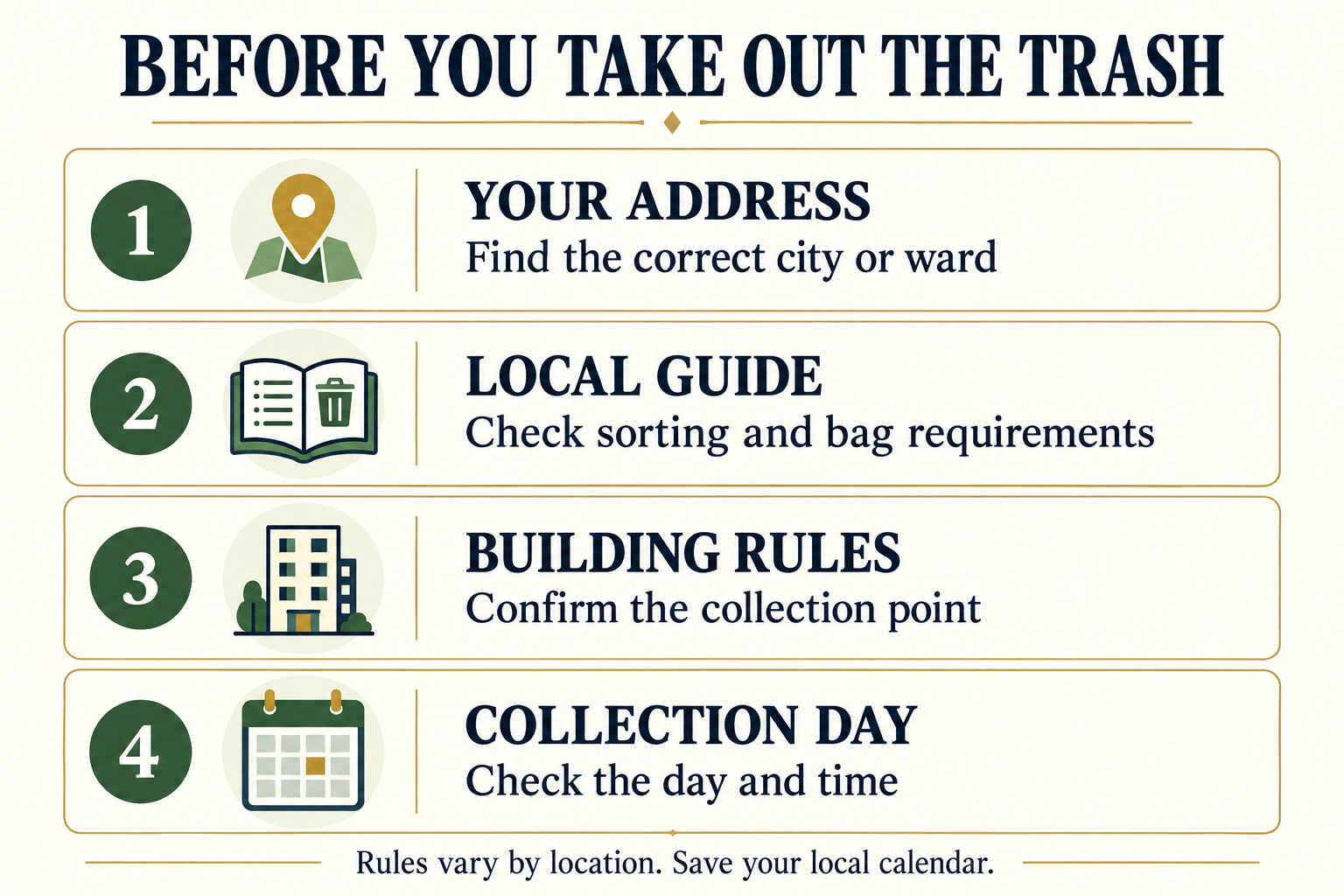
Confirm the location in person or with a photo from the manager. The closest net, cage or bin may serve another building. Add this check to your apartment move-in checklist.
Japan Garbage Rules: Avoid First-Week Mistakes
Most confusion becomes easier to resolve when you know the item's category and who operates the collection point. Keep uncertain items separate while you get the missing instruction.
If your garbage bag is not collected, check the reason
A bag left behind is a reason to investigate, not proof that every item inside is wrong. Check for a notice or sticker and read the collection schedule. The issue might concern sorting, timing, packaging or the collection point; the notice or manager should determine your next step.
Rejected-bag check
- Identify your own bag without opening or handling other residents' waste.
- Photograph any notice and translate it if needed.
- Compare the stated issue with the current official guide.
- Ask the manager how to retrieve, correct and store the bag until the appropriate collection.
Do not move the bag to another building's collection point. If you still cannot identify the problem, send the manager the notice photo and a short description of the contents. Never guess how to handle an item that could injure a collector.
Short stays, convenience-store bins and street bins
If you are staying in a hotel, serviced apartment or short-term rental, ask the host how guest garbage is handled. Do not assume you should take bags to the residential collection point outside. The accommodation may provide its own storage and pickup instructions.
For a short stay, get an answer before checkout, especially if you will leave before the next collection day. Ask where to leave separated bags and whether bottles or cardboard need a different location.
Convenience-store and public bins are not a substitute for your accommodation's household-waste arrangements. Follow the signs and ask staff before using a shop's bins when the intended use is unclear. Carrying a small bag for your own day-trip rubbish is a practical way to avoid depending on finding a bin immediately.
Keep batteries, electronics and bulky items out of guesswork
Do not hide a battery, power bank or rechargeable device inside an ordinary mixed bag. Look up the exact item and battery condition in the municipality's current instructions. Yokohama's current guide, for example, gives separate directions for batteries, devices with non-removable batteries, and damaged or swollen items. Those distinctions matter.
Furniture and large household items also need advance planning. Before moving out, identify what you intend to discard and ask which items require a booking, a fee or a separate collection route. A suitcase or piece of furniture should not simply be left beside the regular bags.
Check before placing it outside: battery type and condition, item dimensions, mixed materials, booking requirements, payment method if applicable, and the confirmed collection location.
The Yokohama guide also lists household appliances the city does not collect through its ordinary system. Avoid generalizing a local size limit or battery route into a national rule, and do not dismantle a device just to make it fit a bin.
Make a first-week card and ask one clear question
Once you have the correct guide, make a small card beside the bins with your own category names, collection days and bag requirements. Leave a blank space for unusual items rather than writing a rule you have not confirmed.
My apartment's garbage card
- Address area: city/ward and collection district.
- Collection point: location or manager-approved photo.
- Each category: accepted bag, preparation and day/time.
- Special items: official lookup link and manager contact.
Check the bag requirements before buying supplies from a 100-yen shop for your first week. Buying the right quantity later is easier than replacing a stock of unsuitable bags.
Copy and adapt this message
Hello, I have just moved in. Could you share the current garbage-sorting guide and collection calendar for this building? Please confirm the collection point, required bags, and when residents may use the garbage area. Where should I keep items that need special collection? Thank you.
This is an original HarukaBase planning template, not a record of a customer conversation. For a short-term stay, replace “moved in” with “checked in” and ask where to leave garbage at checkout.
Planning accommodation in Japan? Explore HarukaBase housing support and prepare your move-in questions before choosing a place. Your municipality and building manager remain the sources for the actual collection instructions.
Japan garbage rules: the quick summary
Use your address to find the current local guide, then confirm the building's collection arrangement. Check category, preparation, bag, place and day together. Separate the parts of an item only as the applicable instructions require.
Save your calendar and first-week card, and ask about uncertain or special items before putting them outside. A reliable local routine is more useful than a supposedly universal list of Japan garbage rules.