
Your first laundry trip in Japan should be a small errand, not an afternoon of guessing which button to press. The useful questions are simple: does this machine wash, dry, or do both? Is detergent included? And where do you pay?
This guide is for short-term students, working holiday participants, and new residents washing everyday clothes. Start with a manageable load and leave unfamiliar bedding or delicate items for another day.
Quick answer: Check your clothes’ care labels, choose the right machine and course, confirm detergent and payment instructions, and note the finish time. Follow the instructions on that particular machine. Japanese laundromats do not all use the same equipment or payment system.
1. Choose washing, drying, or both
Three similar-looking options can do different jobs:
- 洗濯機: washing machine: washes your clothes. Plan how you will dry them afterward.
- 乾燥機: dryer: dries clothes that have already been washed and spun.
- 洗濯乾燥機: washer-dryer: can wash and dry in one machine, but you still need to select the correct course.
A washer-dryer may offer 洗濯のみ, meaning wash only, alongside 洗濯乾燥, meaning wash and dry. The machine’s name alone does not tell you what your selected cycle includes. Seven-Eleven’s official laundry instructions, for example, distinguish washing and drying, washing only, and drying only at the course-selection stage. See the operator’s machine guide.
If your accommodation has a working washer but no suitable drying space, a nearby laundromat’s dryer may be all you need. Ask your host about the in-room machine and house rules first.
2. Check your clothes before leaving home
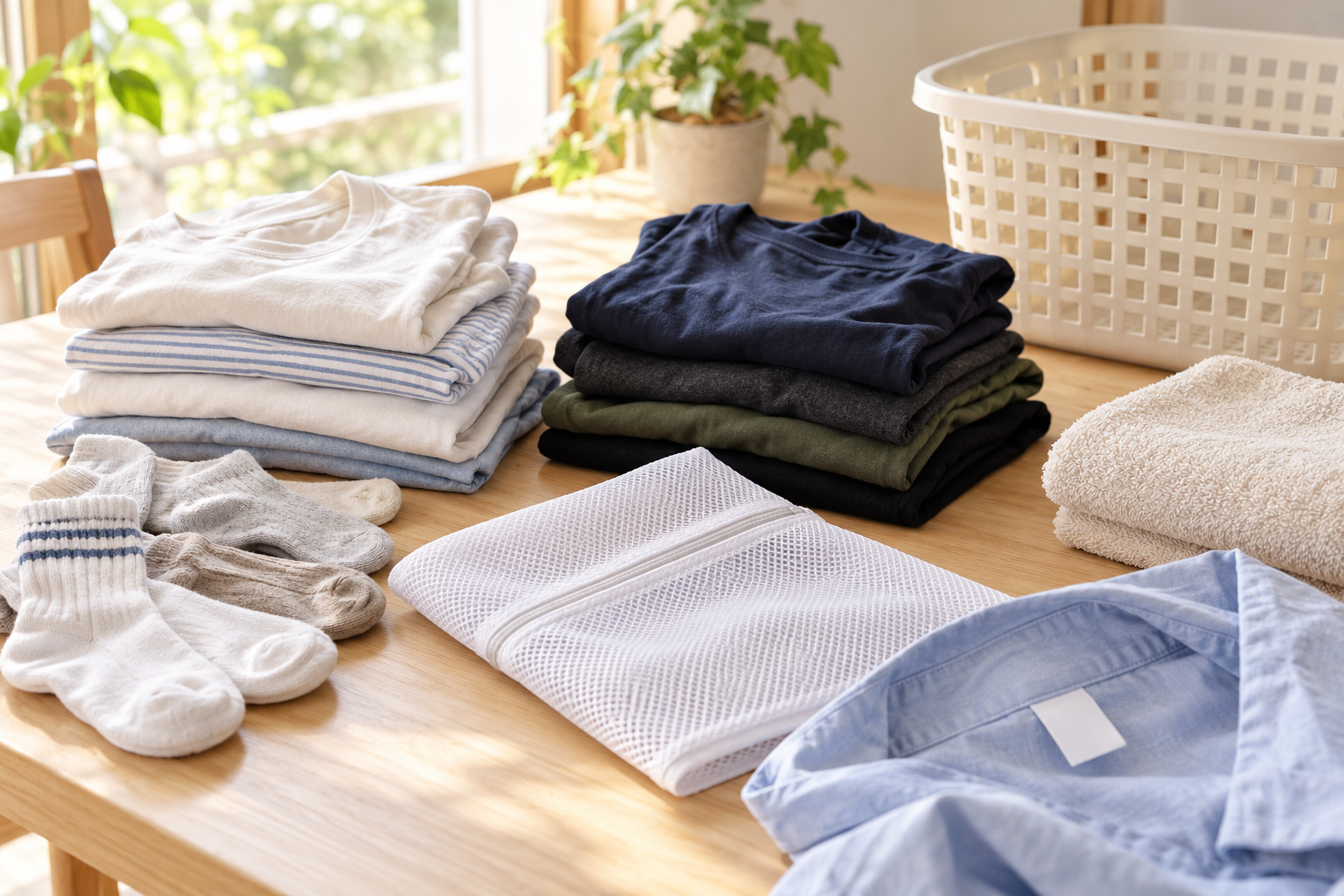
Look at both the washing and drying instructions on each garment. Permission to machine-wash does not automatically mean permission to tumble-dry.
The circle inside a square is the tumble-drying symbol. A cross through that symbol means do not tumble-dry. Other markings indicate the permitted treatment. If the label is unfamiliar, compare it with the Consumer Affairs Agency’s official care-symbol guide rather than choosing the hottest setting to save time.
For a first trip, bring:
- Everyday clothes whose washing and drying instructions you understand.
- A clean bag for taking the finished laundry home.
- Your phone, with the accommodation address saved.
- The payment method accepted by the store, plus suitable cash if available.
Empty pockets and check for pens, coins, tissues, and anything that could damage the load. Do not force clothes into a full drum. WASH House specifically warns that overloading can impair washing and drying and damage clothing or equipment. Read its loading precautions.
If you need hangers or a bag, our first-week 100 yen shop guide can help you keep the shopping list small.
3. Do not add detergent until you check
Buying detergent before your first laundromat visit may be unnecessary.
Baluko’s FAQ says its machines automatically dispense detergent and softener. It also warns against adding your own because extra product can affect the wash and cause excessive foam. A “no softener” option is described in its instructions, but check the controls on your machine. Read Baluko’s detergent and machine FAQ.
There are also different washing systems. In the description accompanying its official Smart Laundry app tutorial, wash-plus explains that it operates detergent-free washing technology. That is another reason not to assume every store works alike.
Look for these words:
- 洗剤: detergent
- 柔軟剤: fabric softener
- 自動投入: automatically dispensed
- 洗剤不要: no detergent needed
- 柔軟剤なし: without softener
If you are using a hotel or share-house washer, check that property’s instructions separately. A neighborhood laundromat’s detergent policy does not tell you how the machine in your building works.
4. Follow the machine’s order, not a universal button sequence
Before paying, take a moment to identify the machine number, course, capacity, price, and payment point.
- Check the drum. Make sure it is empty and suitable to use.
- Read any drum-cleaning instructions. If a rinse function is provided, follow the displayed sequence before putting clothes inside.
- Load to the marked limit. Use the limit for your chosen course, not simply the largest number printed on the machine.
- Confirm the course and payment instructions. Some machines are paid directly; others use a shared terminal or an app.
- Start only when everything matches. Check the displayed machine number before paying at a shared terminal.
- Note the finish time. Set a phone reminder and return promptly.
The order really can differ. Mammaciao’s published guide describes machines where payment comes before course selection and pressing Start. Seven-Eleven’s shared-terminal example has you select the machine and course before payment, after which operation starts automatically. Use the sequence displayed where you are. Mammaciao instructions · Seven-Eleven payment instructions
Capacity also depends on the course. Baluko lists an M-size example with a 17 kg washing capacity but a 10 kg wash-and-dry capacity. Those are not interchangeable load limits. Its guide also notes that equipment and prices vary by store. Check Baluko’s machine guide.
5. Check payment before loading a full bag
“Coin laundry” does not guarantee that every machine is cash-only, and a modern-looking store does not guarantee that your card or transport IC card will work.
Check the payment symbols and instructions at the actual machine or terminal. If an app is offered, check whether you can install and use it with your phone and payment method before relying on it.
Baluko’s guide says its direct coin-payment machines do not give change and directs customers to the store’s change machine. It also describes other payment methods at some locations. Do not put in a large amount expecting a refund of the difference. Baluko payment instructions
For a one-off visit, the simplest option is the method you can clearly confirm and use, rather than an unfamiliar app you are trying to set up with wet laundry waiting.
6. Budget for the whole job, including drying
Compare the full task rather than just the washer’s starting price.
As one operator example, WASH House currently lists clothing washes from ¥300, with a guide time of about 35–46 minutes. Its drying guide gives about 30–40 minutes for clothes, with ¥100 buying approximately 7–10 minutes depending on the machine. These are that operator’s examples, not a nationwide price list. WASH House explicitly says prices can vary by store and time. See the current price-and-time guide.
Before starting, write down:
- The wash price or combined wash-and-dry price.
- Whether separate drying is needed.
- The dryer’s price per time unit.
- The finish time and any store closing time.
Leave some breathing room before class, a train, or checkout. Do not build a tight schedule around the shortest advertised cycle.
7. If something goes wrong, record the details
If you paid the wrong machine, chose the wrong course, or the equipment stops, use the contact information posted in that store. WASH House, for example, directs customers with incorrect course or machine payments to its call center. Do not assume another company can reset the machine. Read WASH House’s troubleshooting FAQ.
Have these details ready:
- Store name or store code.
- Machine number.
- Time and amount paid.
- Payment method.
- Displayed error message or a clear photo of the controls.
Do not force a locked door or repeatedly pay again without checking what happened. Avoid including other customers or payment details in your photos.
Useful Japanese to show staff or read to support:
洗濯と乾燥をしたいです。どのコースですか?
I want to wash and dry my clothes. Which course should I choose?
洗剤は自動で入りますか?
Is detergent added automatically?
料金を払いましたが、動きません。機械番号は__です。
I paid, but the machine is not running. The machine number is __.
Official videos to match to your machine
An operator’s own tutorial is a useful reference when its machine matches the one in front of you:
- TOSEI: SF4-series washer-dryer instructions. Check the model before following the controls.
- Mammaciao TV: washer-dryer introduction. The operator also provides written instructions for several machine types.
- wash-plus: Smart Laundry app tutorial. Relevant to supported locations, not every laundromat in Japan.
Quick questions before your first visit
Do I need to bring detergent?
Check first. The operators above use automatic dispensing or, in wash-plus’s case, a different detergent-free system. Do not add detergent to a machine that says it is unnecessary.
Can I wash shoes or bedding with my clothes?
Do not assume so. Check the item’s care label and the operator’s accepted-item rules. For your first visit, keep the task to ordinary clothing rather than choosing a large machine and hoping everything is suitable.
Can I leave while the machine runs?
Check the store’s rules and return before the cycle finishes. Keep valuables with you and do not leave luggage as a way to reserve the space.
Make laundry part of your first-week plan
Find a workable laundry option before you run out of clean clothes. Save the location, learn one machine, and keep a note of the course and payment method that worked for you.
For the rest of your settling-in errands, use our Japan first-week checklist. If you are still choosing a place for a stay of one month or longer, HarukaBase Housing Support can help you explore accommodation options. Include laundry access and any separate laundry charges in the questions you ask the housing provider.
Information checked: October 24, 2026. This guide draws on official operator and manufacturer publications. Machine instructions, garment care labels, and current store rules take priority over general examples.