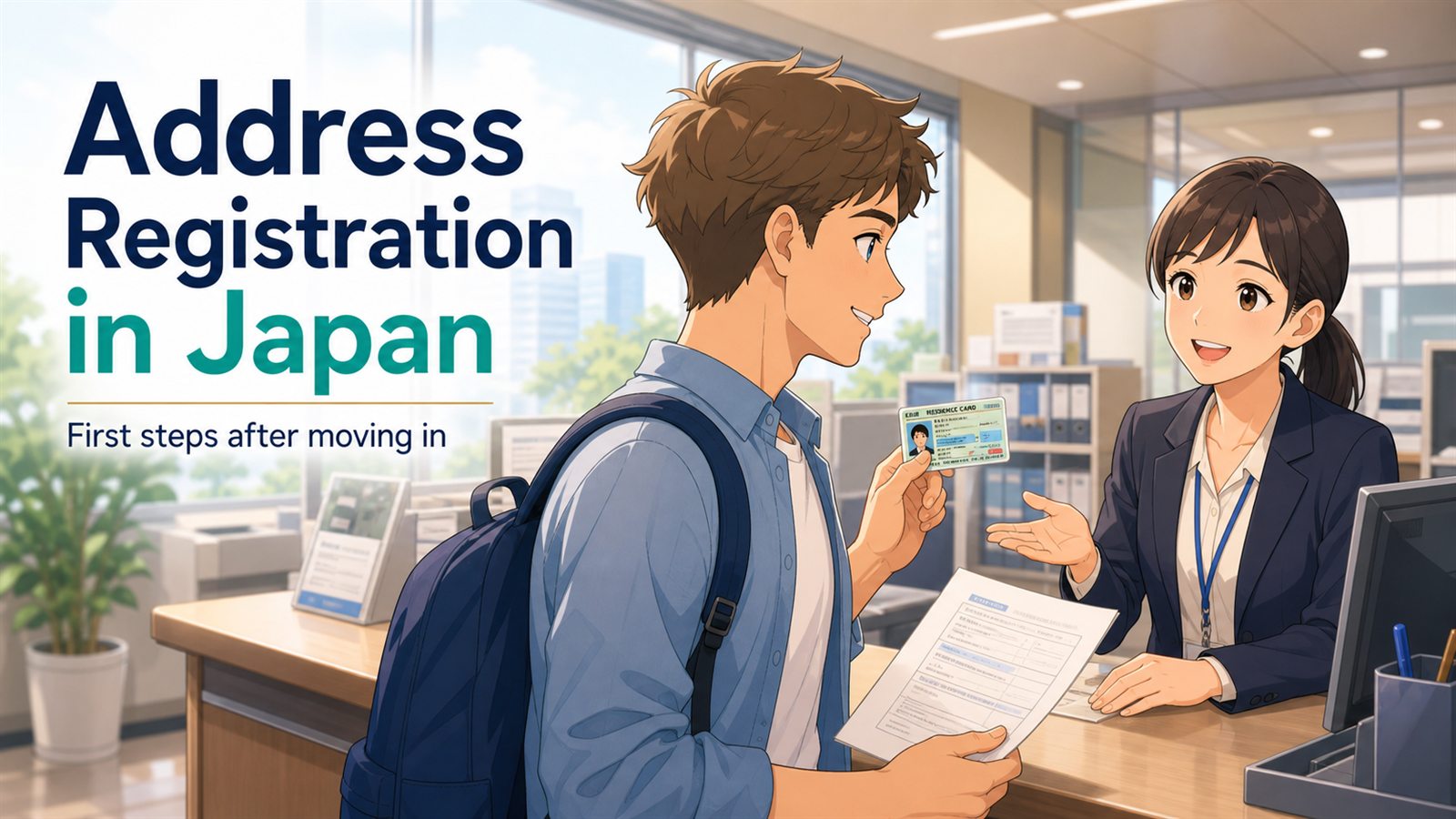
Address registration in Japan for foreigners.
First steps for registering your address at a city or ward office after you arrive or move in Japan.
If you are moving to Japan for school, work, a working holiday, or another long-term stay, address registration is one of the first official procedures you need to understand.
In Japan, mid- to long-term foreign residents generally need to report their place of residence to the municipal office after their address has been decided. This guide explains the first steps in simple English, so you know what to prepare before going to a city hall or ward office.
- You usually need to file a moving-in notification within 14 days after your address is decided.
- Bring your residence card, or your passport if a residence card was not issued at the airport.
- The procedure is handled by the municipal office for the area where you live.
- If you move later, you may need a moving-out, moving-in, or change-of-address notification.
Address Registration in Japan for Foreigners: First Steps
Address registration connects your residence card to your actual address in Japan. It is important because many later procedures depend on it, such as National Health Insurance, banking, phone contracts, school paperwork, and housing-related documents.
If you will live in Japan as a mid- to long-term resident, plan to visit the municipal office for your actual address within 14 days after settling there. Bring your residence card and passport, the full address including room number, and any moving-out certificate, My Number card, National Health Insurance card, family relationship documents, or proof of address your city asks for. If your first stay is a hotel or other temporary place, check the municipality before treating it as your registered residence.
The Immigration Services Agency explains that a person who has been issued a residence card needs to register the address or place of residence within 14 days after establishing a place of residence. If your residence card was not issued at the airport, you may need to bring your passport instead.
HarukaBase tip: do not wait until the last day. City halls can be busy, and you may need extra time if your address format, room number, or household information is unclear.
Who Needs to Register an Address?
This procedure is mainly for foreign nationals who will live in Japan as mid- to long-term residents. Typical examples include students, workers, people on working holiday visas, spouses, and people staying long enough to receive a residence card.
If you are a short-term tourist, your situation may be different. If you are unsure whether you need resident registration, check your visa status, whether you have a residence card, and your municipality’s guidance.
When Should You Go to City Hall?
As a general rule, go within 14 days after your address is decided. This is often after you move into your apartment, share house, homestay, dormitory, or other fixed accommodation.
Some people arrive in Japan and stay in a hotel first. A hotel may not always be treated the same as your fixed place of residence, so you should confirm with the municipal office if your first accommodation is temporary.
What to Bring for Address Registration
Required items vary by city, your status, and your situation, but the basic checklist is usually simple.
| Item | Why it matters |
|---|---|
| Residence card | Your address is registered and printed or recorded in connection with your residence card. |
| Passport | Needed especially if your residence card was not issued at the airport. |
| New address | Prepare the full address, including building name, room number, and Japanese address text if you have it. |
| Moving-out certificate | Needed when moving from another Japanese municipality, because the new city may ask for proof that the old city completed the moving-out step. |
| My Number Card, if you have one | The address may need to be updated on related official cards. |
| National Health Insurance card, if enrolled | Some municipalities update insurance details during the same visit or ask you to bring the card. |
| Family relationship documents, if registering together | A city may ask for documents and a Japanese translation when confirming household relationships. |
| Proof of address, if requested | A rental contract, housing document, dormitory paperwork, or host confirmation can help when the counter needs to confirm the residence. |
Where Do You Complete the Procedure?
Go to the city hall, ward office, or municipal branch office responsible for the area where you live. In many cities, the counter is related to resident registration, citizens’ affairs, or family and resident registration.
If you do not know which office handles your address, search the city name plus “moving-in notification foreign resident” or ask your school, housing provider, or local support staff.
Address Registration in Japan for Foreigners When You Move
If you move after registering your first address, the procedure depends on where you move.
Moving to a different city or ward
You may need to submit a moving-out notification at the old municipality and a moving-in notification at the new municipality. The new moving-in procedure is generally completed within 14 days after moving.
Moving within the same city
You may need a change-of-address notification instead of a full moving-out and moving-in process. Bring your residence card and ask the local office which form applies.
Leaving Japan
If you leave Japan for a long period or move abroad, you may need to file a moving-out notification. The rule can depend on your plan and re-entry status, so confirm before departure.
Common Mistakes to Avoid
- Waiting more than 14 days after settling at the address because the first week feels busy.
- Registering or delaying based on a temporary hotel stay without checking the municipal office.
- Going without the full room number, building name, or Japanese address text.
- Forgetting your residence card, passport, moving-out certificate, My Number card, National Health Insurance card, or family documents when they apply.
- Assuming every city uses exactly the same forms, counter names, translation rules, and proof-of-address rules.
- Moving again and forgetting that a change of address usually needs another municipal procedure within 14 days.
Address registration is easier when your housing and school plan are clear. For arrival transport, see Japan Airport Pickup with English Support. For your first address and move-in plan, see Housing Support in Japan for Foreigners. If your stay is connected to short-term study, check Language School Application Support in Japan.
How HarukaBase Can Help
HarukaBase does not replace official municipal procedures, but we can help you prepare for life in Japan more smoothly. If you are also arranging airport pickup, housing, homestay, a monthly apartment, or school application support, we can help you organize the first steps before and after arrival.
Send your arrival details, housing plan, and questions. We can prepare a quote and explain what support fits your situation.
Ask for a Free QuoteAddress Registration in Japan for Foreigners: Summary and Official Sources
For official and city-specific rules, use the Immigration Services Agency’s Guidebook on Living and Working in Japan, its residence-address notification procedure, and the current guidance from your local municipal office.
Related Setup
Address procedures are easier when your housing option and stay purpose are clear.