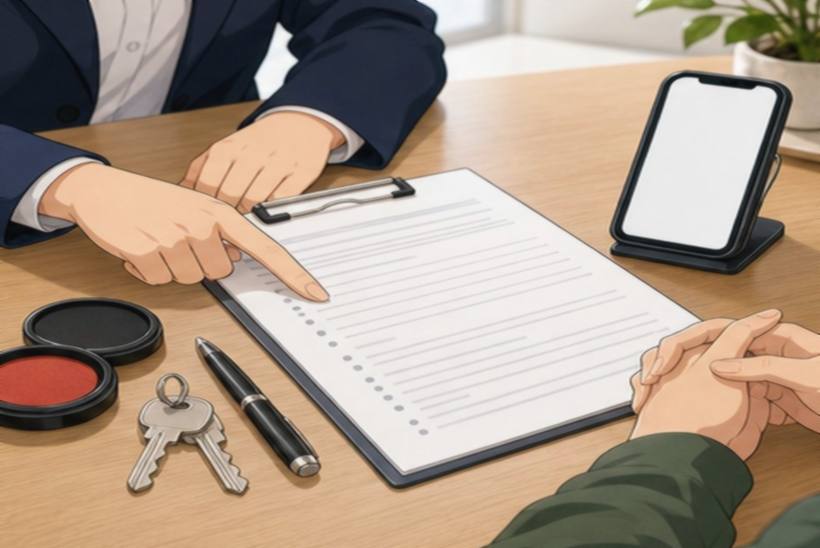
Japan apartment initial costs for foreigners can feel surprising because the first payment is not only rent. A standard rental may involve deposit, key money, agency fee, guarantor or guarantee-company fee, insurance, advance rent, common service fee, cleaning or lock-related items, and bank-transfer timing. The exact items depend on the property, region, landlord, agency, and contract.
Before you apply for a Japan apartment, ask for an itemized first-payment estimate, confirm which items are refundable, check whether a guarantor or guarantee company is required, and make sure the payment deadline works with your overseas bank or Japan bank account. The Ministry of Land, Infrastructure, Transport and Tourism rental guidebook gives a rough initial-payment rule of thumb of 4 to 7 months of rent, but your actual quote can be lower or higher depending on the listing.
- Rent is only the base: first payment can include several contract and screening items.
- Refundable and non-refundable differ: deposit, key money, cleaning, and contract items do not work the same way.
- Payment timing matters: a good listing can disappear if screening and transfer timing are not ready.
- Ask before sending money: confirm contract terms, exact payee, receipt, cancellation rule, and move-in date.
Information checked: July 30, 2026. This guide explains common rental-cost structure for planning. It is not legal, tax, real-estate brokerage, bank-transfer, guarantor-company, landlord, or contract advice. Always follow the actual contract and official/provider instructions.
Japan apartment initial costs for foreigners: what the first payment includes
Quick answer for Japan apartment initial costs
The safest way to understand first payment is to separate monthly rent from one-time contract items. Monthly rent is what you see in listings, but the first invoice often adds deposit, key money, agency fee, insurance, advance rent, common service fee, and guarantee-company cost when required. If you are searching before arrival, this needs to be planned alongside screening documents and the earliest realistic move-in date.
If you are still deciding whether a standard apartment is realistic before landing, start with Can You Rent an Apartment in Japan Before Arrival? and compare it with Share House vs Monthly Apartment in Japan.
Deposit, key money, and regional differences
Deposit and key money are different. A deposit is usually connected to unpaid rent, damage, cleaning, or restoration rules at move-out. Key money is usually a non-refundable payment to the landlord. Some listings have no key money, some have one or more months, and some regions or property types use different wording such as a non-refundable deduction from a larger deposit.
The official MLIT apartment guidebook tells renters to ask about security deposit, key money, shikibiki when relevant, renewal fee, and original-condition restoration before signing. Do not rely only on an English listing summary if the contract or important-points explanation has more detail.
Agency fee, insurance, guarantor company, and advance rent
The first invoice can also include agency fee, damage insurance premium, rent paid in advance, common service fee, and a guarantor or rental guarantee-company fee. The MLIT guidebook notes that a guarantor or rental guarantee company is often required when applying and that the exact fees vary by region and contract.
If the guarantor requirement is the part you do not understand, read Japan Apartment Guarantor for Foreigners. If the emergency contact requirement appears separately, avoid mixing it with the guarantor unless the agency explains that they are asking for the same person or role.
| Item | What it usually means | Question to ask |
|---|---|---|
| Deposit | Money held for unpaid rent, damage, cleaning, or restoration depending on contract. | What can be deducted at move-out, and how is the balance returned? |
| Key money | Usually non-refundable payment to the landlord. | Is this required for this listing, and is any no-key-money option available? |
| Agency fee | Fee paid to the real estate agency for the transaction. | How much is it, when is it due, and is tax included? |
| Guarantee-company fee | Cost for a rental guarantee company when required by the landlord or agency. | What is the first-year cost and renewal or monthly cost? |
| Insurance and service items | Fire, damage, support, lock, cleaning, or other contract-related items. | Which are mandatory, which are optional, and where are they written? |
| Advance and prorated rent | Rent charged before or at the start of the contract, sometimes with partial-month rent. | Which month is covered, and what is the exact move-in start date? |
Documents that affect screening and payment timing
Fees are only one part of the first-payment problem. Screening can require passport, residence card when available, proof of income, employment certificate, student registration certificate, or guarantor-related documents. The MLIT guidebook says renters may be asked about occupation, co-occupants, income, Japanese ability, and why they are looking for housing.
This is why a listing that looks affordable can still fail operationally. If documents are missing, income proof is unclear, arrival date is too late, or the transfer cannot arrive by the agency deadline, the property may not move forward.
Questions to ask before you sign
- Itemized first payment: rent, deposit, key money, agency fee, insurance, guarantor fee, service items, and tax.
- Refund status: which items are refundable, non-refundable, or deducted at move-out.
- Payment deadline and method: bank transfer, sender name, overseas transfer acceptance, receipt, and cancellation timing.
- Contract term: regular rental, fixed-term lease, renewal fee, early termination notice, and move-out restoration rule.
- Move-in day: when keys are available and whether utilities, internet, furniture, or gas opening need separate appointments.
Japan apartment initial costs for foreigners: how to avoid expensive mistakes
Compare share house, monthly apartment, and standard rental costs
A standard apartment is not always the cheapest first-month answer, even when monthly rent looks lower. A share house may have a simpler furnished move-in, but shared rules and screening still matter. A monthly apartment may reduce furniture and utility setup, but rent and cancellation terms can be different from a normal lease. A standard rental can be stable for a longer stay, but the first payment and documents may be heavier.
If you are arriving without a confirmed room, read Arriving in Japan With No Housing before choosing a temporary plan. The cheapest option on paper is not always safest if it leaves you without an address, phone, or clear move-in path.
Payment method, overseas transfer, and receipt checks
The MLIT guidebook says first payment is generally made in cash or by bank transfer. For foreigners paying from overseas, the practical questions are simple: can the agency accept an overseas transfer, what sender name should appear, who pays bank fees, how long will confirmation take, and what receipt or invoice will be issued?
For HarukaBase invoices, use the separate Payment Guide only after you have received an itemized HarukaBase invoice. Do not send housing money to an account unless the payee, purpose, deadline, refund/cancellation terms, and property details are clear.
Move-in day, keys, utilities, and condition photos
Payment does not end the process. After contract signing and payment, you receive the key and move in. The MLIT guidebook recommends checking room condition at key handover and using dated photographs to prevent later trouble. Gas opening, electricity, water, internet, and building rules may require separate steps.
Use the Japan Apartment Move-In Checklist before your first night. Photos of floor scratches, wall marks, appliance condition, meters, keys, mailbox, and existing damage can make later conversations much clearer.
Common fee and contract mistakes
- Comparing only rent: first-payment totals can change the best housing option.
- Ignoring non-refundable items: key money and some service items may not come back.
- Missing guarantor cost: guarantee-company fees can appear in addition to deposit and rent.
- Sending money before confirming the payee: match the invoice, bank account, property, and agency.
- Signing what you do not understand: ask for contract, renewal, cancellation, and restoration terms to be explained.
- Skipping move-in photos: room-condition records protect you when move-out settlement is discussed later.
FAQ about Japan apartment initial costs
How much are Japan apartment initial costs for foreigners?
The official MLIT rental guidebook gives a rough rule of thumb of 4 to 7 months of rent for the initial payment, but actual costs depend on property, region, contract, agency, guarantor company, and timing.
Is key money refundable in Japan?
Key money is usually treated as non-refundable. Deposit is different and may be returned after deductions depending on the contract and move-out condition.
Can I avoid key money or high initial costs?
Sometimes, but not always. You can ask about no-key-money properties, share houses, monthly apartments, or different areas, but the tradeoff may be rent, location, contract length, screening, or availability.
Do foreigners always need a guarantor company?
Not always, but many standard rentals require a guarantor or rental guarantee company. The requirement depends on landlord, agency, property, status, income, and documents.
Can HarukaBase guarantee approval or reduce property fees?
No. Screening, contract terms, availability, and fees are controlled by landlords, agencies, and providers. HarukaBase can help organize questions and support communication within agreed scope.
Send the listing, first-payment estimate, desired move-in date, stay length, household size, documents you have, and your arrival schedule. HarukaBase can help you organize questions for housing support in English/Japanese without changing landlord, agency, guarantor-company, contract, or payment rules.
Japan apartment initial costs for foreigners summary
Japan apartment initial costs for foreigners are easiest to manage when you treat the first payment as a checklist, not a surprise. Ask for each item, separate refundable and non-refundable money, confirm guarantor or guarantee-company rules, check payment timing, and protect move-in day with photos and receipts. If the first payment is unclear, pause before signing and ask for the contract terms to be explained.
Official sources checked July 30, 2026: MLIT Apartment Search Guidebook, Embassy of Japan in the UK Guide to Living in Japan, and Safety Net Housing Information System. Real estate articles and public forum discussions were used only to identify common reader worries, not as factual proof.