If you need a taxi from Tokyo Station with luggage, the hard part is usually not the taxi itself. The hard part is choosing the correct exit, finding a taxi stand while carrying bags, knowing whether one car can fit everyone, and showing the driver a destination that may not be famous. This guide helps you decide when a taxi is worth it and how to avoid a stressful last-mile transfer.
A taxi from Tokyo Station is practical when you have heavy luggage, children, mobility concerns, a late arrival, or a hotel/apartment that is awkward from the nearest station. Use the exit closest to the taxi stand and destination side, prepare the destination in Japanese, check whether your bags fit a normal car, and carry a cash/card backup. For groups or several large suitcases, look for a wagon taxi, use a taxi app, split into two taxis, or arrange a larger vehicle in advance.
- Choose the exit first: Yaesu, Marunouchi, Nihonbashi, and underground routes can send you in different directions.
- Count luggage honestly: a group with several checked bags may not fit one standard sedan.
- Prepare the address: show the hotel name, full Japanese address, and phone number.
- Keep alternatives open: lockers, baggage storage, luggage delivery, train, and taxi each solve different problems.
Station maps, Yaesu taxi information, and fare table rechecked: September 30, 2026. Other provider information was checked on August 4, 2026. Taxi fares, app fees, vehicle supply, payment acceptance, station works, locker availability, and hotel reception rules can change. Use official station, taxi, app, and hotel information for your travel date.
Taxi from Tokyo Station with luggage: choose the right exit and vehicle
Quick route logic: if your destination is a hotel in Marunouchi, Otemachi, Ginza, Nihonbashi, Kyobashi, Shimbashi, Akasaka, Roppongi, Shinjuku, or a first apartment, the best taxi stand depends on which side of Tokyo Station you are already on. Do not drag bags across the whole station just because a map result says "Tokyo Station." Confirm your exit, then move to the taxi area.
If you arrived by Shinkansen with a large suitcase, review the separate oversized luggage on Shinkansen in Japan guide before the train ride. If the bag can be sent instead of carried, compare airport luggage delivery in Japan before you commit to carrying it through Tokyo Station.
When a taxi is better than walking or transferring
A taxi can make sense when the final destination is not one easy train ride, the last walk has stairs or long underground passages, or the traveler is tired after a long route. For a family, a first-time student, or someone carrying two suitcases, a short map walk can feel much harder with luggage.
It is also practical when the destination is a first apartment, dorm, or small hotel that a taxi driver may need to locate by address rather than by brand name. In that case, write the Japanese address and phone number before joining the taxi line.
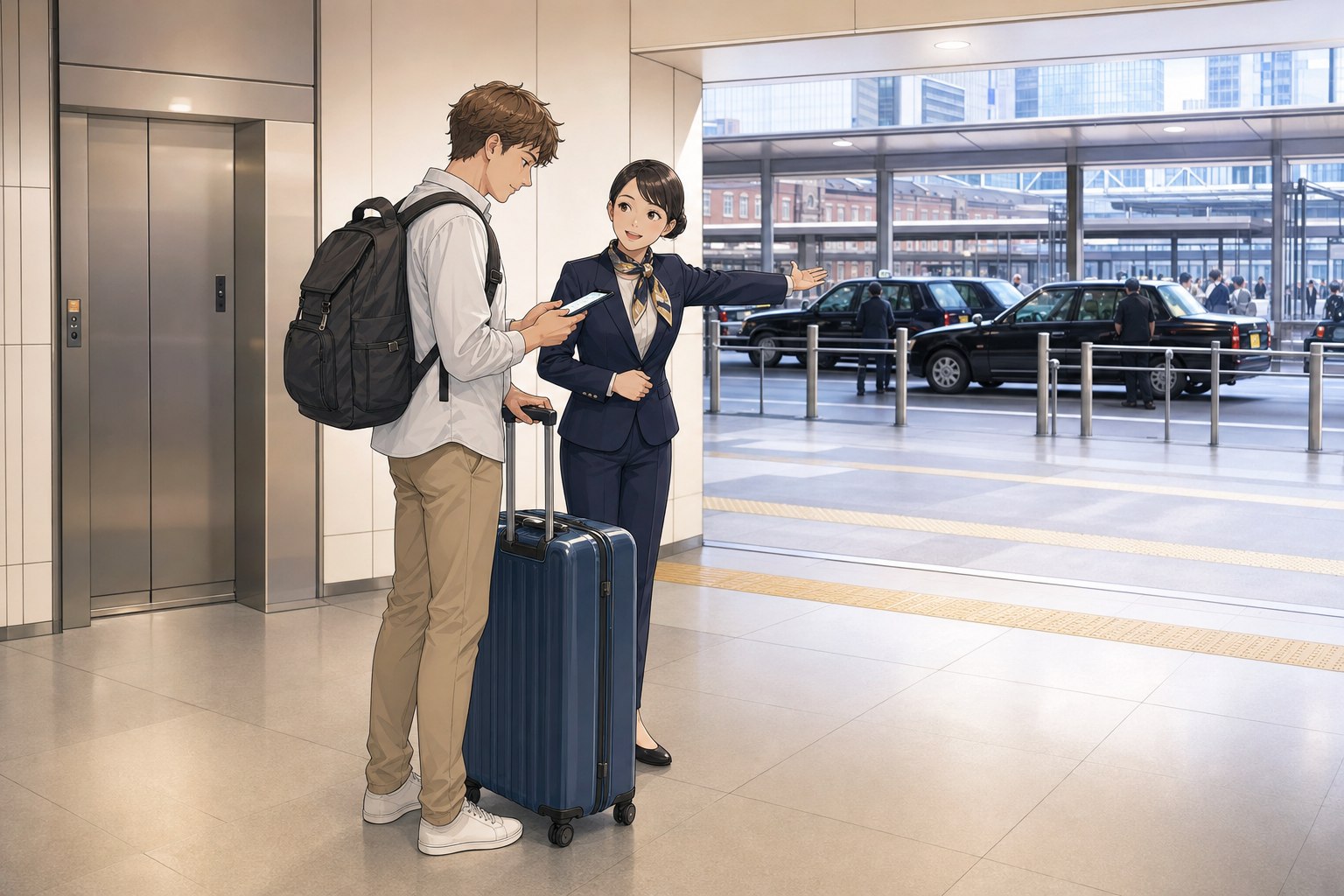
Tokyo Station exits, taxi stands, and baggage storage
Open the Tokyo Station City station and area maps before choosing an exit. Match the gate name on the sign above you to the map, then locate the taxi stand on that side. If stairs are a problem, use the separate accessible route maps for 1F and B1 to plan the path from your gate.
If you are too early for check-in, do not assume a taxi is the only answer. Tokyo Station City lists Shinkansen Parcel Service and Baggage Storage outside the Yaesu South Gate, with luggage transportation and temporary storage, plus other baggage-storage locations inside and outside ticket gates. Availability, hours, and service rules should be checked on the day.
Yaesu taxi lane for wagon and universal design taxis
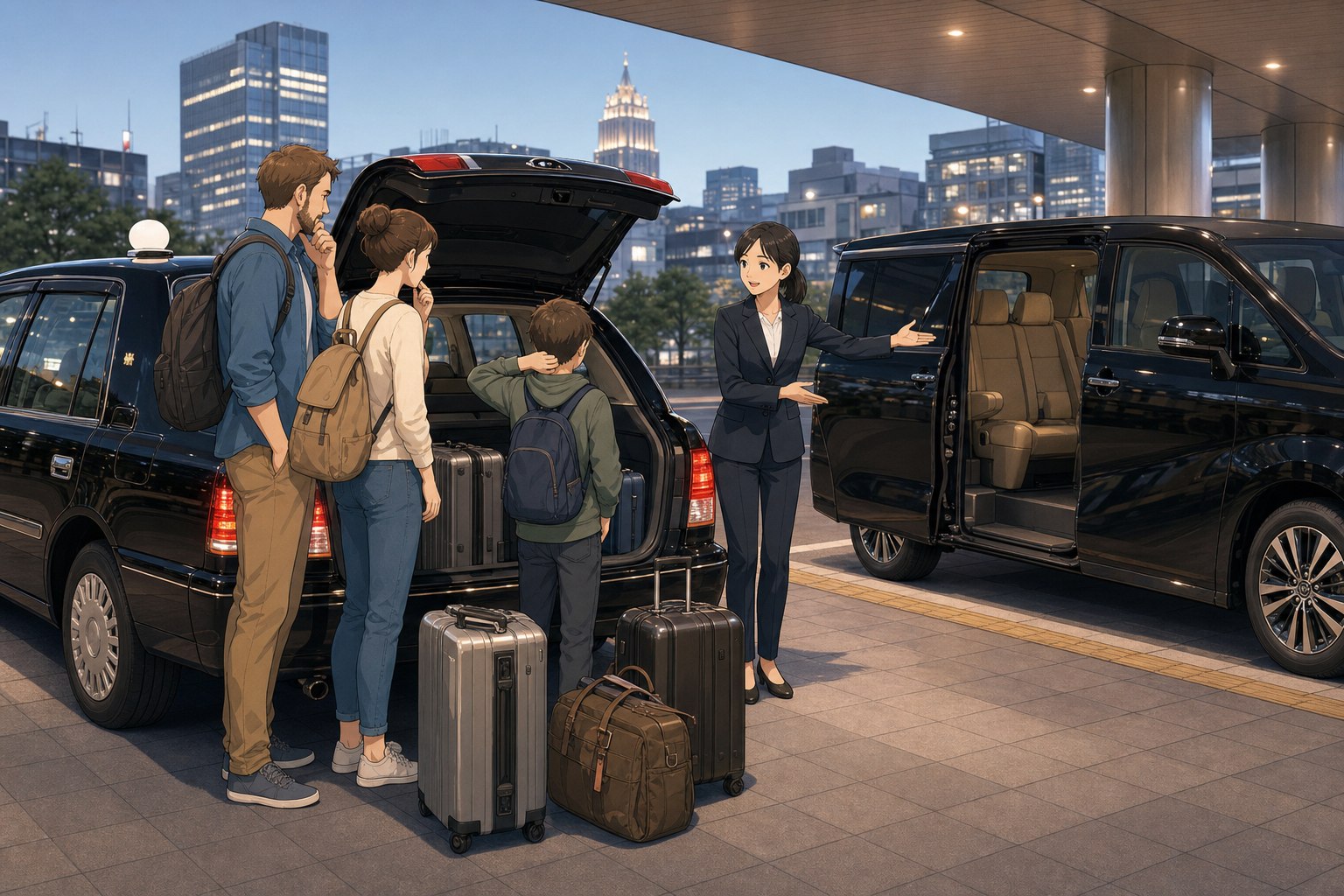
Tokyo Taxi Center states that the taxi stand in front of the Yaesu Exit of Tokyo Station offers exclusive lanes for universal design taxis and wagon taxis. The Center also notes that wagon taxis provide more space for passengers with considerable luggage. This does not mean a larger taxi is always waiting for every group, but it gives travelers with bags a clear place to check first.
If you have a wheelchair, stroller, several suitcases, or a group of four or more, say the luggage count before boarding. When one vehicle is not realistic, splitting into two taxis may be safer than forcing luggage into a car that cannot close properly.
Check the Yaesu queue before crossing the station
Tokyo Taxi Center links to a Yaesu taxi stand congestion page with camera views (Japanese page). Look for 現在の状況 meaning “current situation.” Images can lag or be unavailable; a short visible queue does not confirm that a wagon taxi is waiting.
If you need a larger vehicle, ask the attendant about the appropriate lane and show your passenger and bag counts before joining a queue.
How many suitcases fit in a normal taxi?
There is no universal suitcase count because vehicle models vary. A standard taxi may be fine for one or two travelers with moderate luggage, but a family with four checked bags, backpacks, and a stroller may need a wagon taxi, van, or two cars. The trunk may also be smaller than expected if the vehicle has equipment in the rear.
- Passengers: adults, children, and anyone who needs extra space.
- Large bags: checked suitcases, long items, stroller, or sports gear.
- Carry-ons: backpacks and small roller bags still need space.
- Destination type: hotel front desk, apartment entrance, school dorm, or pickup point.
Cashless payment, apps, and written addresses
JNTO says taxi drivers in Japan use the meter, automatic doors are common, and writing the destination in Japanese is a good idea, especially when it is not a major hotel or sightseeing spot. JNTO also notes that credit cards can generally be used in major city taxis, while cash may be needed in some countryside taxis. Around Tokyo Station, many vehicles are cashless-friendly, but you should still confirm payment before riding if you do not have enough cash.
GO's official English pages say the app lets users set pickup and drop-off locations, receive a confirmation number, and use international credit cards or Apple Pay. GO's pricing page also explains that app requests can involve fare, pickup fee, tolls or parking, app charges, handling charges, and other service charges. Check the fee details screen before requesting a ride.
Taxi fares, meter rules, and late-night surcharge
The Tokyo Hire-Taxi Association rate table for standard-size cars in Tokyo's 23 wards, Musashino, and Mitaka lists an initial fare up to 1.0 km at JPY 500, then JPY 100 per additional 232 meters, with a time-and-distance charge when traveling below 10 km/h. It also lists a 20 percent late-night and early-morning premium from 10 p.m. to 5 a.m. These are official fare-table rules, not an estimate for your exact hotel.
Taxi from Tokyo Station with luggage: plan the hotel or first-address ride
Hotel, apartment, and school address handoff
For famous hotels, the English name may be enough. For apartments, small hotels, share houses, or school dorms, prepare more. The safest handoff is the Japanese hotel name, postal code, full address, phone number, and a map pin. If someone else booked the room, make sure the reservation name and arrival date are also available.
Save this taxi handoff card
Keep your destination's Japanese name, full address, and map pin above these phrases in a phone note. Fill in the passenger and suitcase counts before showing it.
Please take me to this address.この住所までお願いします。
Can ___ passengers and ___ large suitcases fit?___人と大きなスーツケース___個は乗せられますか?
Can I pay by credit card?クレジットカードで支払えますか?
This matters for HarukaBase readers because a first address is often connected to housing, school, payment, luggage, and phone setup. If the ride is part of a longer arrival plan, keep the cash or card in Japan for foreigners guide and the transport and directions Japanese phrase tool open on your phone.

Train, locker, luggage delivery, or taxi comparison
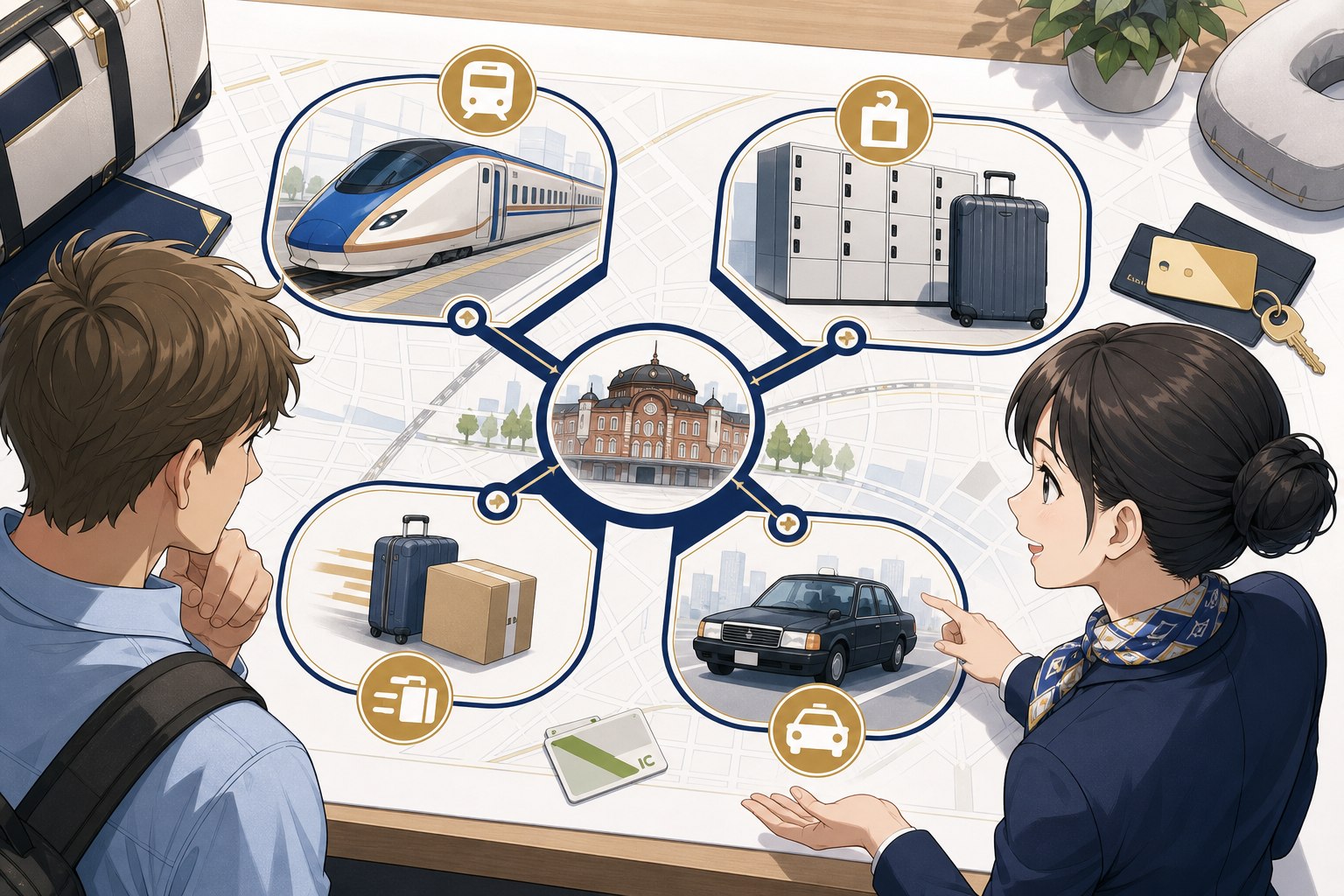
A taxi is not always the best answer. If your hotel is connected directly by one train line and you can handle your bags, the train may be faster. If check-in is later, a locker or baggage-storage counter may solve the time gap. If you do not need the suitcase tonight, delivery can remove the problem. If you need door-to-door movement with luggage now, a taxi or arranged vehicle may be the practical route.
On a small screen, swipe the comparison table sideways to see every column.
| Option | Best when | Watch for |
|---|---|---|
| Taxi from Tokyo Station | You need a last-mile ride to a hotel, apartment, dorm, or first address with luggage. | Exit choice, vehicle capacity, meter fare, payment, and address clarity. |
| Train or subway | You have light bags and a direct or elevator-friendly route. | Crowds, stairs, long underground walks, and platform transfers. |
| Locker or baggage storage | You are too early for check-in or want to move around Tokyo without bags. | Availability, size limits, hours, payment method, and storage duration. |
| Luggage delivery | You do not need the suitcase immediately and the destination can receive it. | Cutoff time, address accuracy, hotel acceptance, and next-day timing. |
| Arranged larger vehicle | Group travel, several large bags, child seats, or first-address uncertainty. | Advance confirmation, vehicle capacity, actual fare, and support scope. |
Common mistakes with Tokyo Station taxis
- Using the wrong side of the station: changing exits with luggage can add a long walk before the ride even starts.
- Assuming one taxi fits the group: large bags, strollers, and backpacks change the vehicle plan.
- Showing only an English hotel name: small properties may need the Japanese address and phone number.
- Depending on one payment method: confirm cashless payment or carry cash backup.
- Forcing delivery when you need the bag tonight: keep essentials with you and confirm acceptance first.
- Changing the destination casually: route, fare, and app terms can change.
FAQ about taxis from Tokyo Station
Can I get a taxi from Tokyo Station with large luggage?
Yes, but vehicle size matters. A standard taxi may not fit a group with several large suitcases. Tokyo Taxi Center identifies the Yaesu Exit taxi stand as having lanes for universal design and wagon taxis, which can be more suitable for considerable luggage.
Should I use Yaesu or Marunouchi for a taxi?
Use the side that matches your current location and destination. Yaesu is often convenient for Shinkansen-side movement, while Marunouchi may be better for some west-side hotels and offices. Check the Tokyo Station City or JR East map before dragging bags across the station.
Do Tokyo taxis take credit cards or IC cards?
Many Tokyo taxis accept cashless payment, but do not assume every vehicle or terminal will work with your card or phone. Confirm before boarding if you lack cash backup. IC cards can be used in taxis where accepted.
Is a taxi from Tokyo Station cheaper than arranging a vehicle?
For one short central ride, a meter taxi can be practical. For a group, several large bags, or a first address that needs support, a larger pre-arranged vehicle may be easier even if it costs more. Compare total risk, not only the base fare.
Can HarukaBase book a guaranteed wagon taxi at Tokyo Station?
HarukaBase can help organize an arrival plan and communicate practical needs, but final vehicle availability, taxi fare, app rules, and taxi-company decisions belong to the operator. Do not treat any vehicle as confirmed until the arrangement is accepted.
If Tokyo Station is only one part of a longer arrival route, send your flight, station arrival plan, destination, passenger count, luggage count, and support needs. HarukaBase can help organize the practical arrival flow in English and Japanese while taxi fare, vehicle size, operator rules, and provider timing remain with the responsible operators.
Review Airport Pickup Support, compare luggage delivery, or send a free inquiry.
Taxi from Tokyo Station with luggage summary
The safe plan for a taxi from Tokyo Station with luggage is to choose the right exit, prepare the Japanese destination, confirm payment, and match vehicle size to the real passenger and suitcase count. A normal taxi can solve many last-mile problems, but groups and several large bags may need a wagon taxi, two cars, a taxi app, luggage storage, delivery, or an arranged larger vehicle.
Next, check the Shinkansen luggage rules, compare luggage delivery, review the Japan payment setup, or use HarukaBase support if your arrival route needs coordination.
Official and provider sources checked August 4, 2026: Tokyo Station City station map and facilities, JR East Tokyo Station guide maps, Tokyo Taxi Center, Tokyo Hire-Taxi Association rates table, JNTO taxis in Japan, GO app official guide, GO pricing, and GO TOKYO IC card guide. Public Q&A discussions were reviewed only to identify real traveler questions, not as factual proof.