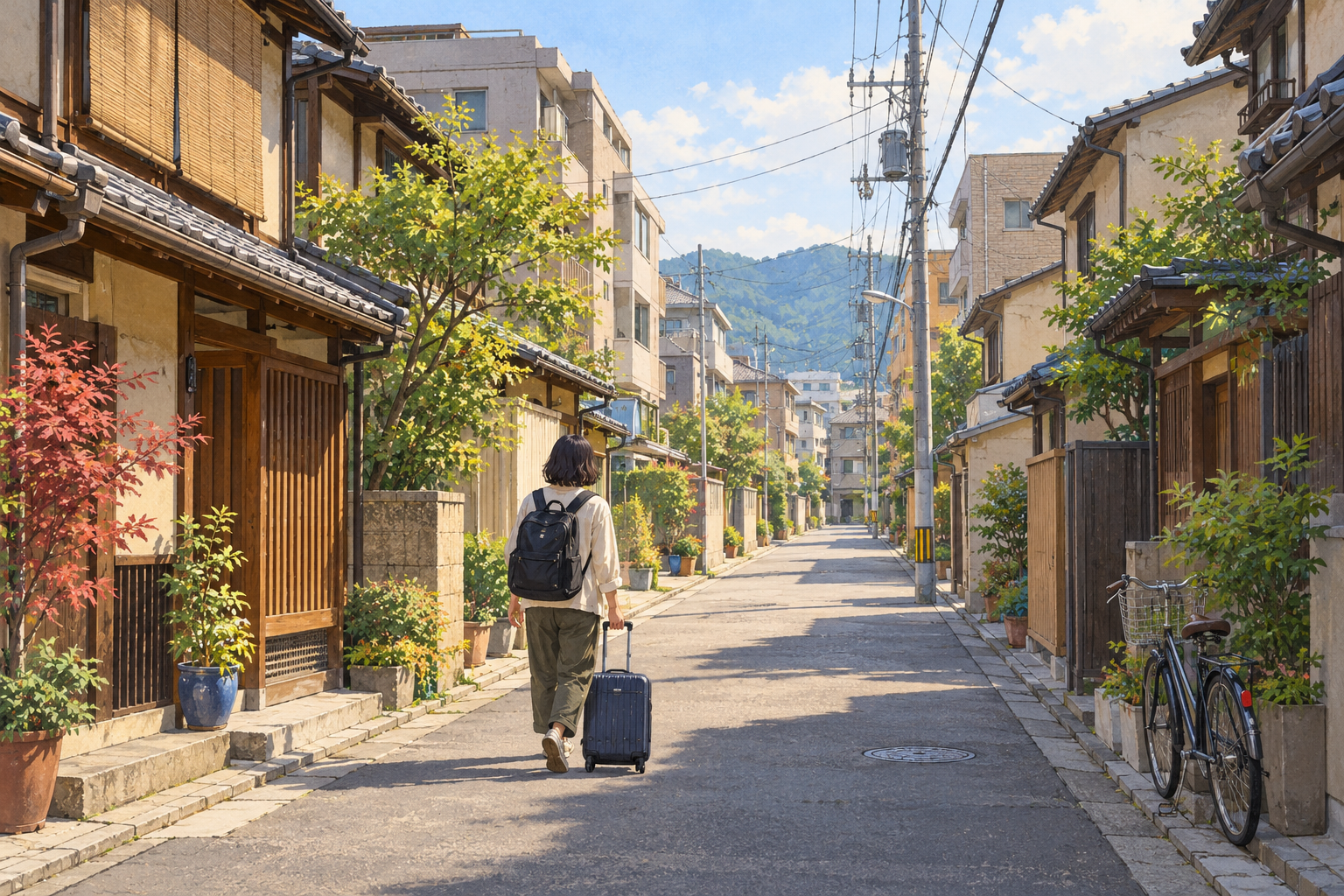
A beautiful Kyoto street can be a lovely place to visit and an awkward place to start a month of classes or work. Before choosing a room, find the route you will repeat most often: accommodation to school, workplace, or the station you actually need.
This guide compares five starting points for a first month in Kyoto: Kyoto Station, Shijo–Karasuma, Nijo, Demachiyanagi, and Yamashina. It is for newcomers comparing a share house, homestay, or furnished monthly apartment, rather than choosing a hotel for a short sightseeing trip.
Quick answer
Start with Kyoto Station if arrival and regular JR journeys are your main concern. Compare Shijo–Karasuma for a central base with subway and Hankyu access, Nijo for JR and the Tozai subway, and Demachiyanagi if your daily destination fits northeastern Kyoto or the Keihan corridor. Add Yamashina when its JR and subway connections match your routine.
These are starting points, not a ranking. The useful comparison is between actual available rooms, their door-to-door routes, and their full first-month costs.
- Choose the daily route first. A convenient airport arrival happens once; a difficult commute repeats.
- Check the exact station name. Nijo and Nijojo-mae are different stations, and “Shijo” can describe a much wider area than the subway stop.
- Use walking videos to investigate, not to book. A recorded street scene cannot establish current noise, room condition, or availability.
- Keep two housing areas on your shortlist. A suitable room in your second-choice district may work better than an unsuitable one in your favorite district.
Information checked: October 24, 2026. Transport services and housing conditions can change. Area recommendations are editorial planning guidance, not claims about live availability, average rents, or the safety of individual addresses.
Five Kyoto areas and the routine each may suit
| Area | Worth comparing when | Check before committing |
|---|---|---|
| Kyoto Station | You expect frequent JR journeys or want a simple arrival base. | Which side of the station the property is on, and the walk from the correct exit. |
| Shijo–Karasuma | Your daily route uses the Karasuma subway or Hankyu Railway. | Whether the listing really means Shijo subway/Karasuma station, rather than somewhere farther along Shijo Street. |
| Nijo | Your routine fits the JR Sagano Line or Tozai subway. | Nijo versus Nijojo-mae, and the route from the room to the station you will use. |
| Demachiyanagi | You need northeastern Kyoto, Keihan Railway, or an Eizan connection. | The actual campus or workplace entrance, river crossings, and the arrival transfer. |
| Yamashina | JR to Kyoto or the Tozai subway makes your regular journey practical. | JR, subway, or Keihan station choice, plus the final walk beyond the station. |
Kyoto Station: useful when your month involves more than central Kyoto
JR-West confirms that HARUKA connects Kansai Airport directly with Kyoto. Kyoto Station also connects with the Karasuma subway, making the area a sensible candidate if those services match your plans. That does not mean every property advertised as “near Kyoto Station” is equally convenient. Check its entrance against the station exit, not just the station pin. JR-West HARUKA information; Kyoto subway lines.
For your first night, save the accommodation’s Japanese address and ask which exit to use with luggage. Kyoto Travel publishes an official HARUKA-to-subway transfer video on YouTube, also linked in its Kyoto Station guide. Preview the relevant route rather than assuming a transfer is a short walk.
Best question to ask: “From the platform I arrive at, which exit and walking route should I use to reach this property?”
Shijo–Karasuma: compare it when central rail connections matter
Hankyu’s Karasuma Station connects with Shijo Station on the municipal Karasuma Line. This makes the area worth considering when your school, work, or repeated Osaka trips fit those lines. Use Hankyu’s station page and map to identify the entrances and transfer.
Be precise with listing descriptions. Shijo subway station, Hankyu Karasuma, Hankyu Kyoto-kawaramachi, and Keihan Gion-shijo are not interchangeable names for one station. Search the exact journey from the room, especially if an advertisement uses a broad phrase such as “downtown Kyoto.”
A central address also needs an everyday test: where will you buy groceries, dry laundry, and work or study quietly? Ask about the room’s street-facing windows and building rules rather than treating the whole district as either noisy or quiet.
Best question to ask: “Which named station and entrance does the advertised walking time refer to?”
Nijo: a practical candidate for JR and east–west subway travel
Nijo offers access to the JR Sagano Line and the Tozai subway. Kyoto’s official travel guidance identifies it as a useful alternative gateway to the city, while the municipal route list clearly separates Nijo from neighboring Nijojo-mae. Kyoto Travel transport guidance; official subway station list.
That distinction matters when searching for housing around Nijo Castle. A room near the castle may be convenient, but it is not automatically a short walk from JR Nijo. Compare the two station routes before you choose.
Keep Nijo on the shortlist if the rail connections reduce your daily transfers. Then verify the practical details at the property: nearest food shop, laundry arrangements, bicycle storage if needed, and the walking route after your normal return time.
Best question to ask: “Will I use Nijo or Nijojo-mae most days, and how far is this room from that station entrance?”
Demachiyanagi: investigate the streets around your actual destination
Demachiyanagi connects Keihan Railway with Eizan Electric Railway. Keihan’s traveler information and official neighborhood maps are useful starting points for checking the surrounding area.
A firsthand video can help you decide what to investigate. The KYOTO’s February 2024 Demachiyanagi walking video describes a route from near Kyoto University to the station, across the river, and into Demachi Masugata Shopping Street. Use that published route as a map-reading exercise: which parts would actually sit between your room and your daily destination?
Do not assume a property “near Kyoto University” is close to your particular building or entrance. Ask the school for the correct arrival point, then compare walking and public-transport routes from the address.
Also plan your airport-day transfer separately. Keihan does not depart directly from Kyoto Station; the official Kyoto Station guide describes a JR Nara Line connection to Keihan at Tofukuji. With large bags, compare the complete route rather than only the final train ride. Kyoto Station connections.
Best question to ask: “How would I get from this room to the exact building I need, in rain and with no bicycle?”
Yamashina: do not rule it out from the map alone
Kyoto Travel describes Yamashina as one stop from Kyoto Station on the JR Biwako or Kosei lines, with an approximate five-minute train ride. Yamashina also has Tozai subway access. Those links make it worth comparing when your routine fits them, even if your initial search focused only on central Kyoto. Official Yamashina access guide.
The short train ride is not a door-to-door promise. Add the walk from the room, platform access, waiting time, and the final walk at your destination. Check whether your planned journey uses JR Yamashina, subway Yamashina, or Keihan Yamashina; the operator and route affect the fare and transfer.
Do not assume Yamashina is cheaper or quieter without comparing real listings. A lower monthly rent may be less attractive if the room adds travel costs or a walk you would not want to make every day.
Best question to ask: “Does this address still work after I include both station walks and my normal return journey?”
Turn the shortlist into a first-month decision

Calculate the journey you will repeat
Choose two or three available rooms and check the route at your actual start time. Record the total walking time, transfers, and expected fare, then check the return journey. If one room saves 20 minutes in each direction on 20 attendance days, that is about 13 hours saved during the month. This is an illustrative calculation, not a forecast for any district.
Keep a wet-weather version of the plan. A room that works only with a bicycle may be less convenient while you are still arranging daily life.
Compare the whole accommodation bill
Ask for the amount payable for your exact dates, not only the headline monthly rent. Check initial charges, utilities, internet, cleaning, deposits, cancellation conditions, and minimum charges. Confirm whether bedding, cookware, and laundry facilities are included before budgeting to buy them.
HarukaBase’s Japan budget planner includes published-price accommodation examples, not live offers or district rent averages. Use it to structure your budget, then replace examples with the provider’s itemized quote. For the housing format itself, read Share House vs Monthly Apartment in Japan.
Check the small details that a district guide cannot answer
- Can the provider accept your intended stay length and move-in date?
- What is the key-collection process, and what happens if your flight is late?
- Is there a lift, or will you carry luggage upstairs?
- What do current room photos show, rather than general building or neighborhood photos?
- Where are the nearest suitable grocery shop and laundry facilities?
- Can you comfortably follow the station-to-door route after dark?
Use social posts and videos to generate these questions. A sunny afternoon recording cannot establish nighttime conditions, the current tenant rules, or whether the room is available.
Plan arrival after choosing the area
Once you have an address, use our Kansai Airport to Kyoto luggage guide to compare the journey. Recheck current operator prices before buying: JR-West has announced a price change for its discounted HARUKA One-way Ticket for purchases from November 1, 2026. The discount also has eligibility conditions, so do not assume every foreign resident or student qualifies. Check the purchase-date prices and eligibility with JR-West.
If your arrival time does not fit the housing provider’s key handover, resolve that before paying for an airport transfer. A temporary first night can sometimes be more practical than trying to make an unconfirmed late move-in work.
Frequently asked questions
Is Kyoto Station the best place for an entire month?
It can be a good fit for frequent JR travel and a straightforward arrival. If your daily destination is elsewhere, compare the complete commute before booking a full month.
Should I choose the cheapest district?
Compare actual rooms, not assumed district prices. Add first-month charges and transport costs, then consider whether the daily route is manageable.
Is Nijo the same station as Nijojo-mae?
No. They are separate stations on the Tozai Line. Check which one the property listing means and whether you need access to JR Nijo.
Can a walking video tell me whether an area is right for living?
It can suggest streets and questions to investigate. It cannot confirm current rent, vacancy, noise at a different hour, accessibility, or the condition of a specific room.
Need help comparing Kyoto housing options?
Send your dates, stay length, budget, preferred housing type, and school or work address. HarukaBase can help check accommodation options and communicate with providers within the agreed support scope. Availability and provider approval are confirmed individually; housing and other provider costs are separate from HarukaBase support fees.
Explore housing support or request a free quote. After choosing your address, continue with the first-week checklist.
Source note: This guide combines official transport and station information with the published descriptions of linked videos. It is not an on-site property inspection or a claim that video footage represents current conditions. No third-party photographs or video stills are reproduced.