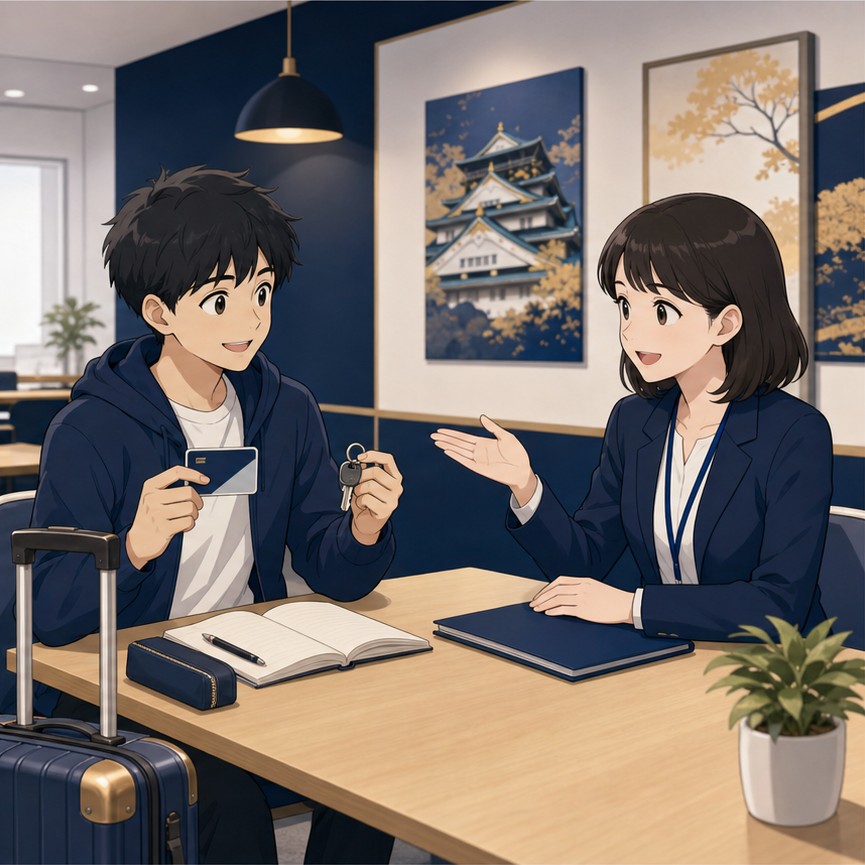
If you want to study Japanese in Osaka short term, the school is only one part of the plan. Course length, visa or residence status, class level, accommodation, Kansai Airport arrival, and first-week setup all need to fit together. A good short course should help you learn faster, not create a housing or arrival problem during week one.
To study Japanese in Osaka short term, first decide your stay length and legal status, then compare schools by class level, schedule, application deadline, housing support, commute, and cancellation rules. Ask housing questions before you apply, plan your Kansai Airport route before booking flights, and keep documents, payment timing, and first-week needs in one checklist.
- Course length changes everything: a two-week course, summer course, working-holiday course, and student-visa route are not the same plan.
- Osaka location matters: school station, housing area, and airport route affect daily stress.
- Ask about housing early: dormitory, homestay, share house, and monthly apartment routes can fill or require documents.
- Confirm with official sources: visa/status rules, school requirements, and accommodation terms must come from the school or authority.
Information checked: July 27, 2026. Course dates, tuition, visa/status handling, housing availability, cancellation rules, and application deadlines vary by school and nationality. This article is planning guidance, not legal, visa, admission, or contract advice.
Study Japanese in Osaka Short Term: How To Choose A Course
Define short-term study before comparing schools
Study in Japan describes short-term study programs as study periods from a few weeks up to a full academic year outside a degree path. That broad range matters because “short term” can mean a vacation course, summer intensive, working-holiday course, company lesson, private lesson, or a bridge before a longer student route.
Before comparing schools, define the route in plain notes: stay length, current status, class goal, housing need, arrival date, and how much English support you need before the first lesson. This prevents you from choosing a course that looks attractive but does not fit your real stay.
Match course length to visa status and schedule
Study in Japan explains that the residence status for studying at Japanese language schools is generally “Student” for the student-visa route, and that a COE application is often handled by the accepting school as proxy. Shorter courses may use other statuses depending on nationality, stay length, and activity, but you should not guess. Ask the school and check the official visa authority that applies to you.
Some provider pages show how varied short-course options can be. For example, ISI describes a Short-Term General Japanese course from a minimum of two weeks for students with a status other than college student visa, while Osaka YWCA lists multiple short-course, evening, JLPT, summer, and private-lesson paths. Treat provider pages as examples, then confirm the latest terms directly.
Compare class format, level check, and goals
The best school for a beginner who wants survival conversation may not be the best school for a learner preparing JLPT, university study, business Japanese, or a working-holiday job. Ask whether the school has a level check, beginner entry dates, class size, lesson hours, homework load, and support language.
If you are still deciding whether a short-term course in Japan is right, read How to Choose a Short-Term Japanese Language School in Japan. Use this Osaka guide after you decide that Kansai is your likely study area.
- Course length: minimum weeks, start dates, term dates, and holiday closures.
- Level placement: beginner entry, level check, class changes, and textbooks.
- Support language: English support before arrival and at the first class.
- Application timing: deadline, documents, payment, and cancellation conditions.
- Housing route: dormitory, homestay, share house, apartment, or independent booking.
Ask schools about housing before you apply
Study in Japan’s accommodation guidance notes that student dormitories may reduce cost and may include furniture or appliances, but rooms can be limited; private housing can involve complicated rental agreements, guarantors, furniture, and other setup issues. Even for a short stay, housing affects attendance and daily energy.
Ask whether the school has dorms, partner accommodation, homestay introductions, share-house contacts, or no housing support at all. If you need housing help beyond the school’s route, compare your options with HarukaBase Housing Support before paying a deposit.
Budget and daily-life planning in Osaka
Study in Japan’s living-cost page shows that student costs depend on rent, commuting, and region, and it warns that apartments near schools in metropolitan areas can be harder to rent. For Osaka, your budget should include the course, housing, commuting, internet, food, insurance where relevant, first-night accommodation, airport transport, and emergency buffer.
Do not compare tuition alone. A cheaper course far from housing can cost more in time and commuting. A comfortable room with unclear cancellation terms can become risky if your dates change.
| Course route | Best fit | Watch for |
|---|---|---|
| Two- to four-week intensive | You want a compact study trip and clear daily schedule. | Beginner start date, accommodation window, and whether the class matches your level. |
| Summer or seasonal course | You want culture activities and a fixed vacation period. | Capacity, application deadline, age rules, and cancellation terms. |
| Working-holiday friendly course | You want Japanese study while living or working in Japan. | Class time, job schedule, housing commute, and status-specific conditions. |
| Private or evening lesson | You need flexibility around work, family, or travel. | Total lesson hours, teacher availability, and whether it feels too isolated. |
| Longer student route | You may study for months or years and need formal application handling. | COE, student visa, school proxy process, documents, deadlines, and housing timeline. |
Study Japanese in Osaka Short Term: Housing, Arrival, And First Week
Choose a first address that fits school life
For short-term students, the first address needs to be practical from day one. Check the commute to school, nearest station, elevator access with luggage, check-in time, internet, laundry, quiet rules, and whether the room can handle your study schedule. A room that looks nice online can be wrong if it makes you miss morning class.
If you are comparing dormitory, homestay, share house, or monthly apartment, use the Japanese language school accommodation timeline and Share House vs Monthly Apartment in Japan as next-step guides.
Plan Kansai Airport arrival before the first class
Most Osaka students arriving internationally will think about Kansai International Airport first. Before booking flights, confirm arrival date, first-night check-in, luggage amount, route from KIX, and what happens if the flight is delayed. If your accommodation starts after the course orientation, add a temporary night rather than arriving with no room.
Use the Kansai Airport arrival guide for the airport flow and transport choices. For broader first-week setup after landing, use the Moving to Japan First Week Checklist.
Documents and payment questions to confirm
Short-term study can still involve documents, payment deadlines, cancellation rules, housing terms, and personal information. If the route is a longer student path, Study in Japan says a COE application may require proof of ability to pay expenses, and schools may act as proxy for the COE process. For short courses, schools may have their own documents and payment rules even without the same student-visa path.
Before paying, ask what is refundable, what is not refundable, what documents are required, whether housing is guaranteed or only introduced, and what happens if your arrival date changes. If the document side becomes the main issue, continue with the short-term Japanese language school application documents guide.
Common Osaka short-term study mistakes
- Choosing only by school photos: class level, commute, and housing support matter more.
- Assuming all short courses work for every status: confirm with the school and official authority.
- Booking housing after flights: first address and check-in can decide whether the first class goes smoothly.
- Ignoring cancellation rules: course and housing payment terms can be different.
- Underestimating Osaka station transfers: luggage, rush hour, and unfamiliar exits can make a short commute longer.
- Not asking for English support: before-arrival communication can be as important as classroom quality.
Frequently asked questions
Can I study Japanese in Osaka for only a few weeks?
Some schools offer short-term or seasonal courses, but start dates, level checks, status rules, age rules, and availability vary. Confirm directly with the school.
Do short-term Japanese courses require a student visa?
Not always, but this depends on nationality, stay length, activity, and current status. Long-term language-school routes are different from short visitor-style courses. Check official guidance and the school.
Is Osaka better than Tokyo for short-term Japanese study?
It depends on your goals, budget, preferred city size, airport route, housing, and school fit. Osaka can be practical if your lifestyle, school, and accommodation are in the Kansai area.
Should I arrange housing through the school?
School housing can be convenient, but it may be limited or rule-heavy. Compare school dorms, homestay, share house, monthly apartment, and independent booking before deciding.
Can HarukaBase guarantee school admission, visa approval, or a room?
No. HarukaBase can help organize questions, compare routes, and support communication within the agreed scope, but schools, authorities, and housing providers make their own decisions.
Send your target study dates, current Japanese level, course goal, nationality/status question, housing preference, arrival airport, first-night plan, and timing worries. HarukaBase can help organize school, housing, and arrival questions in English and Japanese without promising admission, visa approval, room availability, or contract outcomes.
Review School Application Support, review Housing Support, or send a free inquiry.
Study Japanese in Osaka short term summary
To study Japanese in Osaka short term without first-week confusion, define your course length and status first, compare schools by level and schedule, ask housing questions before applying, plan Kansai Airport arrival before booking flights, and keep documents, payment timing, and cancellation rules clear. The best short-term course is the one that fits your real stay, not only your search results.
If you are ready to compare documents, read the application documents checklist. If you are arriving soon, start with the Kansai Airport arrival guide.
Sources checked July 27, 2026: Study in Japan short-term programs, Study in Japan immigration and student visa guidance, Study in Japan accommodation guidance, Study in Japan living-cost guidance, Study in Japan school search limitations, ISI short-term course example, Osaka YWCA short-course example, and Kansai Airport train access. Provider pages are examples only; confirm latest terms directly with each school.